The Taj Faluknuma Palace, Hyderabad

Falaknuma Palace is one of the finest palaces in Hyderabad, Andhra Pradesh, India. It belonged to Paigah Hyderabad State, and it was later owned by the Nizams.

It is on a 32-acre 129500 Sq. Mtr (1393910 Sq. Ft) area in Falaknuma, 5 km from Charminar. It was built by Nawab Vikar-ul-Umra, the then-prime minister of Hyderabad and the uncle and brother-in-law of H.H. The Nizam VI, Nawab Mir Mahboob Ali Khan Bahadur. 


Falaknuma Palace is also known as the 'mirror of the sky' because at 2000 feet, it was built in the clouds and reflects the ever-changing moods of the sky. 

Built in 1894, it took ten years and four million rupees for its magnificent, physical evolution in the shape of a scorpion. Designed by British architect William Mard Marret, the Palace took a rumoured 22 years to perfect and has been owned in turn by Sir Vicar-Ul-Umra, PM of the State of Hyderabad, Nizam Mahboob Ali Pasha and Mir Osman Ali Khan Bahadur.


Bought over in 1895 and used as the residence of Nizam VI until 1911, Falaknuma Palace later went on to be used as a royal guesthouse for dignitaries, including free India's first President Dr. Rajendra Prasad who availed of its famed, lavish hospitality in 1951. The echoes of visiting European monarchs, the Duke of Windsor, heads of state and distinguished governors can still be heard in this newly refurbished inner sanctum of Hyderabad. Since 1995, The Taj Group of Hotels has sensitively restored the palace not only to accommodate the privileged in 60 glamorous rooms and suites, but also to accommodate the extravagance of the 'then' with all the comfort of the 'now'.


Design

The foundation for the construction was laid by H.E. Sir Vicar Ul Umra Bahadur on March 3, 1884. He was the great grandson of Khuddus, a famous scientist who was a best friend of Sir Charles Darwin. It took nine years to complete the construction and furnish the palace. Sir Vicar moved into the Gol Bangla and Zanana Mahel of the Falaknuma Palace in December 1889 and closely monitored the finishing work at the Mardana portion. It is made completely with Italian marble and covers an area of 93,971 square meters.


The palace was built in the shape of a scorpion with two stings spread out as wings in the north. The middle part is occupied by the main building and the kitchen, Gol Bangla, Zenana Mehal, and harem quarters stretch to the south. The Nawab was an avid traveler, and his influences show in the architecture.
The Falaknuma palace is a rare blend of Italian and Tudor architecture. Its stained glass windows throw a spectrum of colour into the rooms.


Since the palace was the private property of the Nizam family until recently, visitors weren't allowed. Occasionally, however, the venue is opened for public.


Renovation into a luxury hotel

In 2000 Taj Hotels started renovating and restoring the palace. The renovated hotel was opened in November 2010. The rooms and halls were decorated with ornate furniture, rich handcrafted tapestries and brocade from France. 


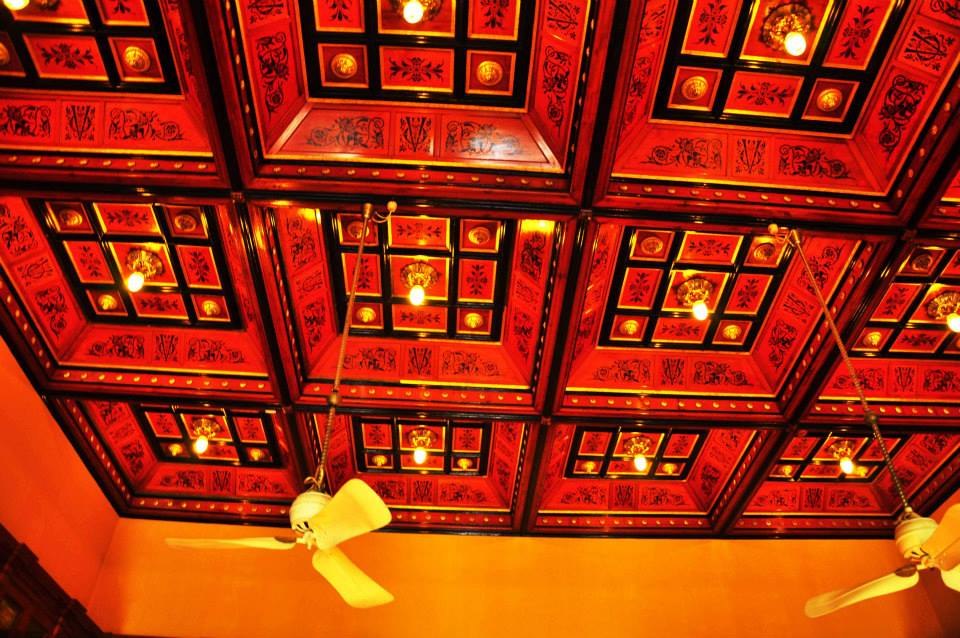
The interiors are a splendid interplay of Venetian chandeliers and intricate frescos and have charming outdoor terraces with a treasure of rare artefacts, including paintings, statues, furniture, manuscripts and books. The palace has a 101-seat dining hall, considered the largest in the world, and the Durbar Hall, embellished with intricately carved wooden ceilings, parquet flooring, regal walnut wood furniture and handcrafted mirrors.


HOTEL ADDRESS
Taj Falaknuma Palace,
Engine Bowli, Falaknuma, 
Hyderabad - 500053, India
Telephone: +91 40 6629 8585 

Apple Store, Fifth Avenue

767 Fifth Avenue, New York, NY 10153

Living up to its “Think Different” motto, Apple unveiled flagship Store, Fifth Avenue in New York City. Located at 767 Fifth Avenue between 58th and 59th Streets, the prominent site near FAO Schwarz and Bergdorf Goodman provides views of Central Park. 

The stores sell Macintosh personal computers, software, iPods, iPads, iPhones, third-party accessories, and other consumer electronics such as Apple TV.
The store occupies the underground retail concourse of the General Motors Building, with entry from the plaza level above. "The new plaza in front of the General Motors building on Fifth Avenue at 59th Street is a triumph of urban design." said James Gardner in the New York Sun. "Suddenly, as if out of nowhere, New York has a new public space that will prove to be a source of civic pride and aesthetic delight."

Designers Bohlin Cywinski Jackson and structural engineers Eckerlsey O'Callaghan (glass elements) in collaboration with Apple used Apple Stores' signature structural glass vertical circulation to entice plaza level passersby down to the store's underground main level. The 32-foot structural glass cube marking the store's entrance makes a bold architectural statement. Housing a transparent glass elevator wrapped by a circular glass stair, the transparent cube beckons potential customers down to the retail level below. By day it is a skylight bringing natural light underground, while at night the lighted cube is a sign. "It was in Apple's DNA to try to make something that no one else had the vision to create," said Ron Johnson, Apple's Senior Vice President of Retail.

Visitors descend the glass stair or travel in the all-glass elevator, entering a carefully tailored stainless steel and stone environment where Apple's products take center stage. Custom-designed wooden store fixtures, stainless steel ceiling and wall panels and an Italian stone floor make an elegant, yet restrained backdrop.

Cybertecture Egg


James Law Cybertecture International

The 32,000 sq m egg-shaped building will combine “iconic architecture, environmental design, intelligent systems, and new engineering to create an awe-inspiring landmark in the city.

James Law have been commissioned by Vijay Associate (Wadhwa Developers) to create an office unlike any other in Mumbai, India. It will accommodate 13 floors of offices. 


The Cybertecture Egg is a Cybertecture building that brings together iconic architecture, environmental design, intelligent control systems, and evolutionary engineering to create the most innovative building for the city of Mumbai and for India in the 21st Century.

Technology and the working environment are united in the use of ‘cybertecture reality’ which allows you to customize your favorite view and have real time scenery all around the world instead of the view the user currently has.

The egg itself is orientated and skewed at an angle to create both a strong visual language and to alleviate the solar gain of the building, also there is a sky garden on the top of building which performs thermolysis (the dissipation of heat from the surface). PV panels will be installed on top of the building and a wind turbine on the sky gardens will generate electricity. A water filtration system will also be incorporated into the building to recycle grey water for flushing and irrigation purpose.

By using this “Egg” shape, compared to a conventional building, the structure has approximately 10-20% less surface area. Within the building, an innovative structure derived from the skin of the egg creates up to 30m spans of columnless floors. The architecture is sleek and computer designed, with engineering that creates a building of high quality and geometric sophistication. It is hoped this building will act like a “jewel” for the new Central Business District of Mumbai, and will be a worthy neighbour to other esteemed buildings in the district.

Green facts & awards

Orientation of Building: The building is orientated towards the 
ideal direction vis a vis the sun to minimize solar and heat gain.
Sky Gardens: Green areas of the building will provide sun 
shading, oxygen replenishment, refuge areas for people as well 
as cooling for building and wetland filter beds for water 
recycling.
PV Farms: Photovoltaic cells are integrated into the façade 
facing the sun to help provide an alternative electricity source.
Intelligent Glass Façade: The building’s glazing will have 
variable fritting and tones based on sun orientation, as well as 
variable shading and tinting.
Water Recycling System: The recycling of potable water is done 
through a combination of rain water harvesting systems, 
sewerage treatment and filtration, and wetland cell systems. 
These effectively recycle up to 20% of the water supply 
consumption of the building.
Underground Water Cooling: Related to the water recycling 
system, the underground cooling system embedded deep 
underground in a reservoir provide naturally chilled water for the building’s air conditioning.
Intelligent Building Management Systems: BMS to reduce 
energy use in less utilized or less occupied locations.

Kerala Architecture

Kerala is a state of India in the southern tip with Arabian Sea kissing its sands on the western long side. On the eastern side, hilly plantations and greenery rich with spice plantations like cardamom, coffee, tea, pepper. From the east to west from hilly green forests to seashore, several rivers flow to join lakes and finally flowing down to join with the sea. A real delight for the eyes and psyche of any tourist, Kerala is the most beautiful state of India and even one of the most beautiful places in Earth.

Kerala also has got a rich history of art, culture and naturally architecture of its own. People from all over the world used to come to Kerala mainly for spices produced by eastern hilly regions of Kerala. They brought along alien culture, languages, religions and architecture. Kerala Architecture of today is influenced by the alien culture and architecture brought by people and cultural influences brought by them to Kerala from outside the state and outside India. But original Kerala Architecture has its own unique features.

Nalukettu is the traditional houses or heritage homes of Kerala and these types of buildings are typically found in Kerala only. Nalukettu is the traditional style of architecture of Kerala, was the hallmark of the grand mansions of yore in Kerala.  In early times, such huge structures were essential to cater the needs of the huge tharavad (upper class homestead), since most of them were accommodated a large number of families under the marumakkathayam (matrilineal system).


The best examples of nalukettus are the Padmanabhapuram Palace, Dutch Palace at Mattancheri and the Krishnapuram Palace near Kayamkulam.


Nalukettu are once again entering the purview of prestigious homesteads. The structure got its name from its architectural peculiarity, which consists of four blocks joined together in a square form with an open roof central courtyard, corridors, massive pillars and wide verandahs.


New Office Interior for Astral Media by Lemay Associés

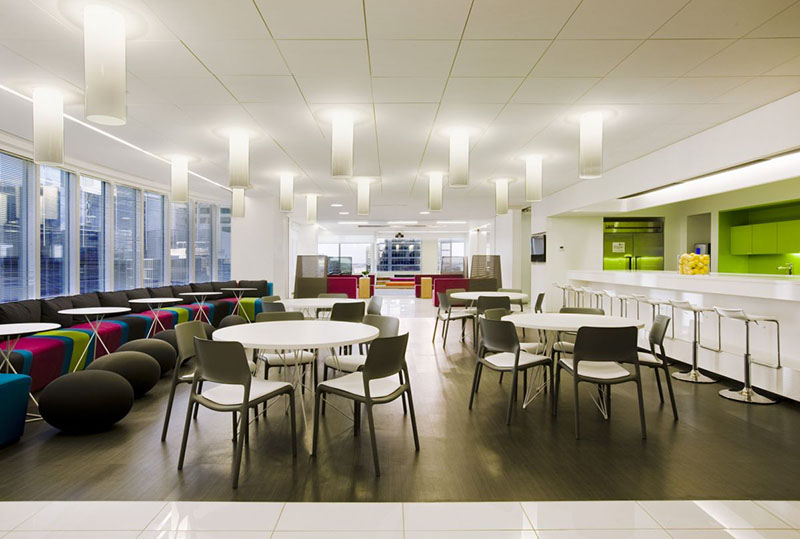
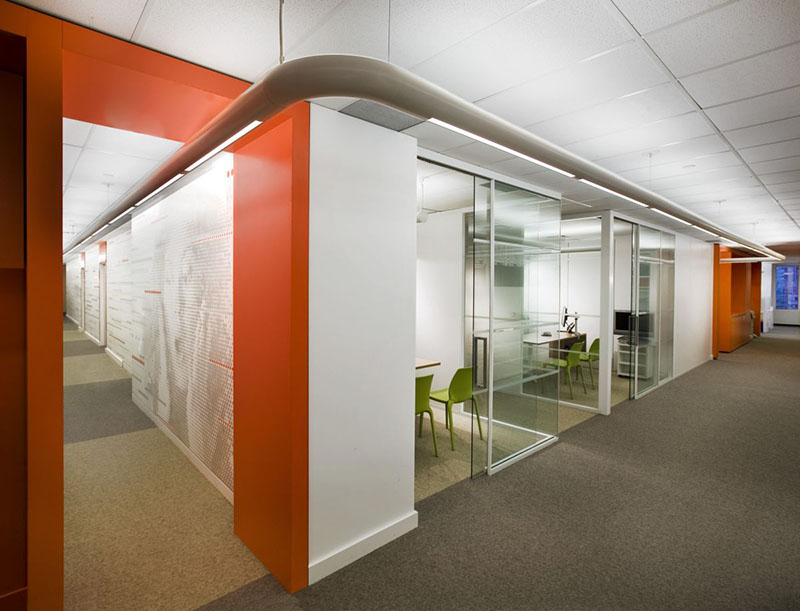
Montreal-based architecture and interiors firm Lemay Associés has designed the interior of a new office for Astral Media in Montreal, Canada. Following is some information from the designers, “In the spring of 2010, Astral Media relocated approximately 350 employees to four (4) floors in downtown Montreal. Based on the client’s four different business units (radio, television, advertising and digital media), our concept was inspired by key broadcasting industry words such as influence, communication, movement and exchange. The concept plays on the contrast between the medium and the message and manifests itself by means of undulating and pixelated graphic interventions.


Aside from workstations, we fitted up a main reception area, various meeting spaces (conference and meeting rooms, agora, etc.) as well as common services (dining room, lounge, café, copy centre) on each floor. In order to create a rhythm and a gradation throughout the playful 6,000 m2 space, each floor was  identified with its own colour and the levels were linked by a central glass staircase.