The American Institute of Architects (AIA) and its Committee on the Environment (COTE) have selected the top 10 sustainable architecture and green design solutions.
The top 10 includes:
- City of Watsonville Water Resources Center by WRNS Studio. The new 16,000 square foot building consolidates three different city and county water departments and includes administrative offices, a water quality lab, educational space and a design that puts the story of water in California on display. The building, its systems and its landscape will serve to educate the public through exhibition and guided tours.
The top 10 includes:
- City of Watsonville Water Resources Center by WRNS Studio. The new 16,000 square foot building consolidates three different city and county water departments and includes administrative offices, a water quality lab, educational space and a design that puts the story of water in California on display. The building, its systems and its landscape will serve to educate the public through exhibition and guided tours.
King Abdullah University of Science & Technology
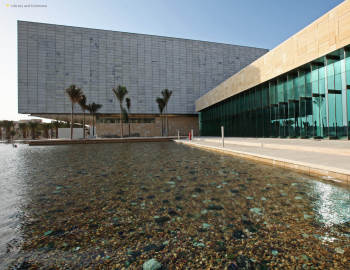
- KAUST, Thuwal, Kingdom of Saudi Arabia by HOK. KAUST's new campus is the Kingdom of Saudi Arabia's first LEED certified project and the world's largest LEED Platinum project.

Kroon Hall
- Kroon Hall by Hopkins Architects and Centerbrook Architects & Planners. Replacing a brownfield site, Kroon Hall was charged with being a net zero energy building. The project has a mix of active and passive design measures and visible, invisible and interactive building features.
- Manassas Park Elementary School + Pre-K by VMDO Architects. The school is conceived throughout as a teaching tool that shepherds children along a path of environmental stewardship. Interior extended learning spaces offer views of the neighboring mixed oak forest, while elementary classrooms face shady moss and fern-covered learning courtyards featuring 'fallen' trees.
- Manitoba Hydro Place by Kuwabara Payne McKenna Blumberg Architects and Smith Carter Architects and Engineers. The project was designed utilising a formal integrated design process to achieve goals of energy efficiency, healthy workplace environment, urban revitalisation, sustainability and architectural excellence. At 88 kwh per sqm annually, from a demand side, it is the most energy efficient large office tower in North America, with a 66 per cent improvement over the standard.

355 11th Street
- 355 11th Street by Aidlin Darling Design. The project is a LEED-NC Gold adaptive reuse of an historic (and previously derelict) turn-of the-century industrial building. The design team implemented a strategy of introducing subtle perforations into new zinc cladding to allow light and air into the occupied spaces.
- Michael J. Homer Science & Student Life Center by Leddy Maytum Stacy Architects. The design encourages scientific inquiry, linking the school’s science curriculum to building functions throughout the seasons – how it breathes, resists gravity, conserves precious resources and generates energy.
- Omega Center for Sustainable Living by BNIM Architects. The Center has been designed to clean water, return the clean water to the local systems and educate users about the process. Eco-Machine technologies were selected to clean the water, utilising natural systems including the earth, plants and sunlight. The entire building and water process utilise site harvested renewable energy achieving a net zero energy system.
- Special No. 9 House by KieranTimberlake. The project was designed to provide storm-resistant, affordable and ustainable housing options for the residents of New Orleans’ Lower Ninth Ward displaced by Hurricane Katrina. Key goals were to create safe, healthy and dignified housing to residents in a flood-prone area and to empower residents to return to improved living conditions that take advantage of New Orleans’ climate.
- Twelve|West by Zimmer Gunsul Frasca Architects LLP. Twelve|West was designed to achieve the highest levels of urban sustainability and is expected to earn a platinum rating under LEED NC overall and LEED CI for the office floors. An emphasis was put on selecting low-impact materials, including salvage, reclaimed and FSC-certified wood. Much of the concrete building structure is exposed on the interior minimising the use of finish material and providing ample thermal mass.
- KAUST, Thuwal, Kingdom of Saudi Arabia by HOK. KAUST's new campus is the Kingdom of Saudi Arabia's first LEED certified project and the world's largest LEED Platinum project.

Kroon Hall
- Kroon Hall by Hopkins Architects and Centerbrook Architects & Planners. Replacing a brownfield site, Kroon Hall was charged with being a net zero energy building. The project has a mix of active and passive design measures and visible, invisible and interactive building features.
- Manassas Park Elementary School + Pre-K by VMDO Architects. The school is conceived throughout as a teaching tool that shepherds children along a path of environmental stewardship. Interior extended learning spaces offer views of the neighboring mixed oak forest, while elementary classrooms face shady moss and fern-covered learning courtyards featuring 'fallen' trees.
- Manitoba Hydro Place by Kuwabara Payne McKenna Blumberg Architects and Smith Carter Architects and Engineers. The project was designed utilising a formal integrated design process to achieve goals of energy efficiency, healthy workplace environment, urban revitalisation, sustainability and architectural excellence. At 88 kwh per sqm annually, from a demand side, it is the most energy efficient large office tower in North America, with a 66 per cent improvement over the standard.

355 11th Street
- 355 11th Street by Aidlin Darling Design. The project is a LEED-NC Gold adaptive reuse of an historic (and previously derelict) turn-of the-century industrial building. The design team implemented a strategy of introducing subtle perforations into new zinc cladding to allow light and air into the occupied spaces.
- Michael J. Homer Science & Student Life Center by Leddy Maytum Stacy Architects. The design encourages scientific inquiry, linking the school’s science curriculum to building functions throughout the seasons – how it breathes, resists gravity, conserves precious resources and generates energy.
- Omega Center for Sustainable Living by BNIM Architects. The Center has been designed to clean water, return the clean water to the local systems and educate users about the process. Eco-Machine technologies were selected to clean the water, utilising natural systems including the earth, plants and sunlight. The entire building and water process utilise site harvested renewable energy achieving a net zero energy system.
- Special No. 9 House by KieranTimberlake. The project was designed to provide storm-resistant, affordable and ustainable housing options for the residents of New Orleans’ Lower Ninth Ward displaced by Hurricane Katrina. Key goals were to create safe, healthy and dignified housing to residents in a flood-prone area and to empower residents to return to improved living conditions that take advantage of New Orleans’ climate.
- Twelve|West by Zimmer Gunsul Frasca Architects LLP. Twelve|West was designed to achieve the highest levels of urban sustainability and is expected to earn a platinum rating under LEED NC overall and LEED CI for the office floors. An emphasis was put on selecting low-impact materials, including salvage, reclaimed and FSC-certified wood. Much of the concrete building structure is exposed on the interior minimising the use of finish material and providing ample thermal mass.


